
I am a comic book enthusiast and a feminist. Most of the time this makes me very very sad. Although Wonder Woman first appeared in 1941 paving the way for hundreds of costumed heroines the representation of ladies in the industry, she is still soul- crushingly disproportionate. I can barely get through a month without being told that sexist material sells or that no one else is interested in seeing the stories that I want to see.
Of course one quick trip to Tumblr proves that I am not alone, but I am frustrated that the industry, that me and my fellow fangirls put so much time and energy into, has little interest in acknowledging that we exist. It certainly wouldn’t hurt the brand to throw a sexy Nightwing book our way, or to do something about Loki opening up a bakery with like, Benedict Cumberbatch or something.1
Whatever… It’s not like I’ve plotted fifty chapters worth of fanfiction in my head or anything….
The worst part is when I talk about comics and feminism together people look at me like I am the unreasonable one. As if it is somehow totally natural for an entire segment of the entertainment industry to alienate well over half of its potential readers. Seriously. Comics are so bad that people actually don’t believe they could even possibly portray women in a positive way.
That is wrong on a ton of levels. There is not a single reason comics and feminism can’t get along. In fact there are plenty of truly amazing and feminist comics already available and they need more people to read them.
Today I want to talk to you about one of my all time favorite comics, and one of the best superhero books of the last fifteen years, Batgirl: Year One. I had originally planned this to be a “review” of the of book to celebrate DC finally republishing it; however, my best friend pointed out that a “review” is different than a “love note.”
First, some history. Barbra “Babs” Gordon, is a truly wonderful character and an even better feminist icon. The original Batgirl and Batwoman were Betty and Katherine Kane, romantic foils for Batman and Robin. By “romantic foils” I of course mean “sexist parodies of human beings” who were constantly getting in danger so the Dynamic Duo could bail them out.

Their stories were less than fantastic mostly involved Batman being a gigantic clit-tease.
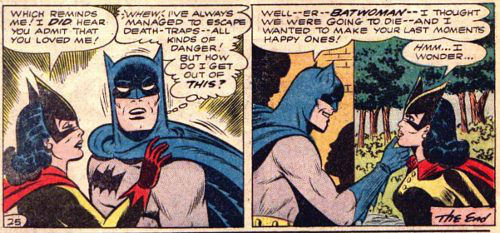
They were fun in a “oh man old comics you guys,” way but not a “what an awesome portrayal of women,” way.
By 1967 Betty Kane Batgirl had been scrapped. In order to broaden the appeal of the 1966 Batman TV series writers Gardner Fox and Carmine Infantino decided to revisit the Batgirl concept. This Batgirl was designed to appeal to appeal to young women, not the hero fantasies of young men. Barbara was a butt-kicking Phd. with a Marvel-esq emotional plot hook of being Jim Gordon’s daughter. In other words: she was a person.
DC liked her so much they put her in comics. Rather than dialing back the agency of the character like you might expect, they amped it up. In her premier issue Barbara Gordon saves Bruce Wayne from Killer Moth during a hostage crisis. That’s right she friggen’ saves Batman in his own book!
As time went on Ms. Gordon fell prey to crappy writers like every comicbook character. However, coded into her DNA was a decidedly feminist theme. She rises above all of the misogynistic bullshit in comics. Even when the DC executives allowed Allen Moore to “cripple the bitch,” in The Killing Joke, Gordon came back as Oracle, the brilliant hacker who wouldn’t let a physical disability stop her from fighting crime.

Batgirl triumphs over adversity, that is just who she is. When writers Scott Beatty and Chuck Dixon along with artists Marcos Martin, Alvaro Lopez, and Javier Rodriguez and letterer Willie Schubert were tasked with reinventing the character for Year One they had a fabulous wealth of themes to draw upon. Thankfully, this creative team was up to the task and their chosen central themes were feminism and independence.
In many ways Batgirl: Year One mirrors the classic “I-can-do-anything-a-man-can-do” story ala Sweet Polly Oliver.2 Unlike Polly Oliver or Mulan, Barbara doesn’t seek out the mask because she is lookinging for a purpose. She knows her purpose. Barbara is an incredibly gifted human being and she is driven to use her gifts to help people. Nobody gave her these gifts either, Dixon and Beatty paint Barbara Gordon into a totally self-made woman. She knows what she wants and how to get it.

Or, she would know how to get it if it weren’t for the damn patriarchy. Most of the sexism Babs faces is not the cartoonish villainy you are used to seeing when pop culture pays lip service to gender equality. It is that subtle bullshit that women put up with every day.

The men standing in Barbara’s way believe their own bullshit. Just like in real life, the men in Batgirl: Year One don’t see themselves or their dumb rules as sexist. They just only know one reality. In their world, cops are tall powerful men who protect small defenseless women. Barbara, who is an ideal candidate for law enforcement has the door shut in her face because no one thinks to question the rules.
The great thing about her decision to become Batgirl is it has nothing to do with her wanting to be like men. She does it because men are getting in her fucking way. The costume is 100% her idea. Year One takes place a during a time when The Batman is more of an urban myth than a fact of life for the long-suffering people of Gotham. Originally she just puts on the costume to show her dad that she is her own keeper, but when disaster strikes…

She finds her destiny.
Barbara’s experiences with patriarchy is not limited to men swatting away her dreams. In Year One sexism is as ubiquitous as it is insidious. Literally every man she meets either underestimates her or hits on her.

This is reflected spectacularly in Martin’s masterfully constructed panels. The male gaze is used as a storytelling tool rather than a default perspective for the reader. Most of the time Babs is portrayed the way a male hero would be portrayed: active with a strong focus on her power, not her body.

The only time the male gaze rears it’s ugly mug and the comic flirts with that fetishistic vouyerism we are soued to is when Robin is leering at her.3

even then, Martin handles it with tasteful grace.
Batgirl: Year One is meant to introduce readers to the universe where she becomes Oracle after Moore’s Killing Joke.

There is a sense of doom throughout Year One but unlike the story that injures her Year One never a makes her a victim. Dixon and Beatty really understand Barbara. She is a Judo feminist. She takes all the negativity and awfulness the world throws at her and turns it around.

As long as you are willing to suspend your disbelief to allow for a comicbook world, Batgirl: Year One is an intensely satisfying and fun story with a poignant social message that never gets in the way. But I did not write this because I want you to have fun.
In 2003 DC published the minimum run of trade paperbacks (TPB) for Batgirl: Year One and it went out of print pretty quickly. It is really only due to a happy accident that I managed to discover this series at all. If a series doesn’t sell out of its first run of TPBs It is likely to go out of print- that is how the industry works but I feel that Year One fell victim to a self-fulfilling prophecy in the comics industry. One that has kept comics a boys club for decades and continues choke the industry to this day.
When DC did its New 52 relaunch, I attended to the retailer’s summit in Chicago when they opened up the floor for questions I was seething. I had just been told that Harley Quinn’s iconic and thematically appropriate design was being changed from this:

to this:
:

in an attempt to be more accessible to female fans. Because it was “easier to cosplay.” Ugh. While I was trying not to picture the creative team behind Suicide Squad leering at female fans in booty shorts and ill fitting corsets, someone stood up and asked a question I had been afraid to:
“If you want to expand your audience to include more young women why don’t you publish more books like Batgirl: Year One? I know I can sell that.”
This question was met with applause and DC editor in chief Dan Didio sidestepping the issue, claiming “books go out of print because not enough people buy them.”
At the time that Mr. Didio was trying to convince me and a room full of skeptical retailers that people simply were not interested in Batgirl: Year One, the trade paperback was selling as a collector’s item online for $145. The UK editions can go for up to $470. TPBs are not traditionally collector’s items. It usually only happens when there is a story that people are really interested in reading and can’t find for some reason.
A few short years before that, Paul Dini, the much renowned creator of Batman : The Animated Series read Year One and was so inspired that he petitioned DC to allow him to turn the book into an animated series, or at least one of DC’s direct to DVD animated features. His plan was rejected.4
My point is, the industry heads are so committed to the idea that hey have a one sex market even when a project comes along that has the potential to expand the readership they sabotage it, claiming the move is based on “industry wisdom.”
This year on June 26th Batgirl: Year One is finally getting re-published as a combined volume with Robin: Year One. If you are a longtime comics fan, buy this book. If you have always been interested in reading comics, but never got around to reading any, buy this book. If you have always dismissed comics as adolescent male wish-fulfillment fantasies, buy this book. If anything I said even remotely interests you, buy this book. I promise, you will not be disappointed.
I want the re-print of Year One to be an unmitigated success. It may sound like I am just shilling for DC at this point, but I don’t care if you notice them. I want them to notice you. I want DC editorial to see that feminism sells. I want to prove to those old, white, male bastards that publishing material that empowers women is a good business strategy.
One day, when I have a daughter, I want to share my love of comics with her. Growing up, comics were and great source of entertainment and intellectual stimulation. That is something that should belong to everyone. No one should ever have to feel like an outsider when they pick up a comic book or enter a comic shop. In order to do that, we have to challenge the industry’s expectations and encourage good story-telling.
I believe good stories can change the world. Maybe I am being overly optimistic, and all you will get out of this book is a really good read. However, a bet against this book is a bet against Barbara Gordon, and you couldn’t sell me those odds in a million years.

1Someone please draw me a picture of this. The sexual tension would be insane you guys.
2This is a british folk tale about a young woman who cuts off her hair and dresses like a man to join the army.
3Please don’t let this give you a bad impression of Robin. He is nomally a wonderful and respectable character. He just happens to be fifteen during this story.
4Dini was given a nod during the series finale of Batman : Brave and the Bold when his vision was brought to life in a 20 second animated tribute to Batgirl: Year One which I guess is something.

